How AI detectors work, and what their scores cannot tell you
Separate classifier scores, statistical watermarks, and exact Unicode findings. Understand false positives and use a fair, evidence-led review process.
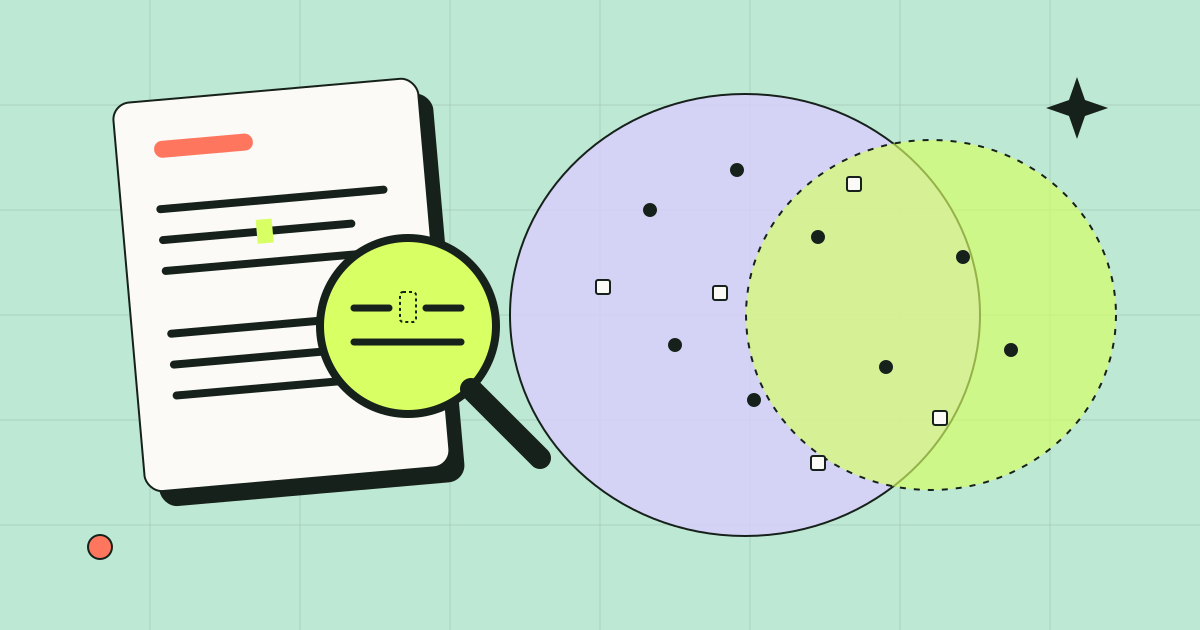
A text can contain an invisible character, resemble examples used to train an AI detector, and carry a generation-time statistical watermark. These are different findings. They require different methods, support different conclusions, and should never be compressed into one confident verdict about who wrote a document.
Start by asking what the tool measures. An exact code point is directly observable. A classification score is an inference. A watermark check depends on a particular generation system and a compatible detector. Understanding the distinction makes the results easier to use fairly.
What a general-purpose classifier measures
Many AI detectors learn patterns from collections labeled as human-written or machine-generated. Others use statistics related to how predictable a passage is under a language model. Some combine several methods. They compare features of new text with patterns learned or defined during development.
Predictability is sometimes discussed through perplexity: roughly, how surprising the words are to a particular model in context. Repeated structure or a narrow vocabulary may influence some methods. Neither is exclusive to AI writing. Human instructions, technical documentation, and routine business messages can also be highly predictable.
The displayed score might be a class score, a confidence estimate, or a share of qualifying text that crossed a threshold. Read the tool's definition. “90% AI” does not automatically mean a 90% probability of machine authorship or that nine out of ten sentences were generated. Different tools can use different scales.
Why a false-positive rate is not the answer you want
A false positive occurs when human-written text is flagged. A false negative occurs when generated text is missed. Both rates depend on the test population and the decision threshold. A detector can reduce one error by accepting more of the other.
Here is a deliberately hypothetical example, not a vendor benchmark. Imagine 1,000 documents, of which 100 are generated. A detector catches 80 of those and incorrectly flags 5% of the 900 human documents: another 45 flags. It produces 125 positive results, of which 80 are correct. Only 64% of the flagged documents are generated in this scenario.
That calculation illustrates why an advertised error rate does not by itself tell you how much to trust a positive result. Change the proportion of generated documents or the test conditions, and the answer changes. A meaningful evaluation needs the relevant population, threshold, and both kinds of error.
Performance changes with the text and the test
Length, language, topic, model family, and editing history can change a detector's behavior. A threshold tested on long English essays may not transfer to short customer messages. A tool should say when the input falls outside its supported scope rather than assigning every passage a persuasive-looking score.
The RAID benchmark tests detectors across generators, domains, and changes to generated text, documenting robustness and generalization problems. That finding argues for testing on the intended use case, rather than treating a single accuracy figure as universal.
Fairness also requires attention to the actual population. Liang and colleagues' 2023 study found substantial false-positive problems on non-native English writing in its tested setup. A 2026 study of Czech essays reported different patterns and no systematic bias across the detector families it examined. Language, dataset, and method matter; neither result establishes that every current tool behaves identically.
Statistical watermarks use a different mechanism
A generation-time text watermark can influence which otherwise suitable tokens a model selects. A compatible detector looks for that statistical pattern across enough text. It is not simply classifying familiar writing style after the fact.
The SynthID-Text paper describes such a method and evaluates its detection characteristics and limitations. The signal is encoded through token choices, rather than by appending a visible badge or a zero-width character. Checking one provider's mark requires the relevant method and detector access; a generic Unicode scanner cannot substitute for it.
A result is also limited in scope. Absence of a detected mark does not establish that text is human-written. A positive result concerns the relevant watermarking system, not every possible tool or the origin of the ideas. Human revision and mixed drafting histories make broad authorship labels even less informative.
Invisible characters are exact evidence with context
Unicode includes characters that affect spacing, joining, and direction without appearing as ordinary letters. Examples include a zero-width space, a non-breaking space, and directional controls. A scanner can name a supported character and point to its position in the current string. That observation is more specific than an AI-style score.
It still does not identify an author or source. Copying from a website, PDF, or rich-text editor can carry unusual characters. Some characters are intentional: joiners affect writing systems and emoji sequences, and direction controls can support mixed-direction text. The Unicode display FAQ describes several categories of invisible formatting characters.
Review the exact code point and surrounding text before changing it. Keep an original and an undo path. Removing all invisible characters can damage legitimate content, and removing them does not clear a token-based watermark. The invisible-character field guide explains these boundaries in more detail.
Use a review process that matches the evidence
For editing, use a result to identify a question: is this paragraph repetitive, is that claim supported, or is this character intentional? AIssistify's free inspector separates exact Unicode findings from transparent English editorial cues. It does not expose a trained authorship classifier or certify that a passage is human-written.
For a consequential review, preserve the text and method details, ask for drafts or source notes, and let the writer explain the process. Examine citations, factual consistency, and the applicable disclosure rules. Do not turn one score into an accusation or treat a low score as clearance.
Keep the tool version, date, language, passage length, and limitations with any recorded result. Our detector field guide offers a longer review protocol. If the writing needs improvement, use the rewrite playbook to edit for clarity and fidelity. The goal is a document you can evaluate, rather than a score you can make disappear.